Category: Power Wheelchair
Posted by 2026-01-06 10:01
hoyer lift quiz answers
Explanations for Hoyer Lift Knowledge Quiz Answers: Master Key Points of Safe Operation Thoroughly
Testing your mastery of Hoyer Lift knowledge through quizzes is a crucial step to ensure safe operation. hoyer lift quiz answers This article provides detailed explanations for typical quiz questions, helping you gain a deep understanding of the principles and basis behind each answer.
Explanations for Equipment Knowledge Questions
Question 1: What is the standard weight capacity range of a Hoyer Lift?
Correct Answer: 300–450 pounds (136–204 kilograms)In-depth Explanation:
Standard models are designed with a weight capacity of 450 pounds (204 kilograms).
A 20% safety margin should be reserved during actual use.
Heavy-duty models can support 600–1000 pounds.
The weight capacity is clearly marked in a prominent position on the equipment.
Question 2: What are the main advantages of a hydraulic Hoyer Lift?
Correct Answer: Smooth control and cost-effectivenessKey Points:
Hydraulic systems provide a smoother lifting and lowering experience.
The mechanical structure is simple, resulting in lower maintenance costs.
No electricity is required, making it suitable for a wider range of usage scenarios.
It is ideal for environments with limited budgets.
Explanations for Safe Operation Questions
Question 3: What is the most important safety check step before operation?
Correct Answer: Conduct a comprehensive inspection of the sling and equipment integrityDetailed Explanation:
Check if the sling has any wear or tears.
Confirm that the safety lock function of all hooks works properly.
Test the hydraulic system or electric functions.
Verify the stability of the base and the functionality of the wheel brakes.
Question 4: How should you respond if the user reports discomfort?
Correct Answer: Immediately stop the operation and assess the situationProper Handling Process:
Pause lifting or moving immediately.
Communicate with the user to identify the cause of discomfort.
Evaluate whether medical assistance is needed.
Document the incident and report it to the relevant supervisor.
Do not resume operation until the issue is resolved.
Explanations for Technical Operation Questions
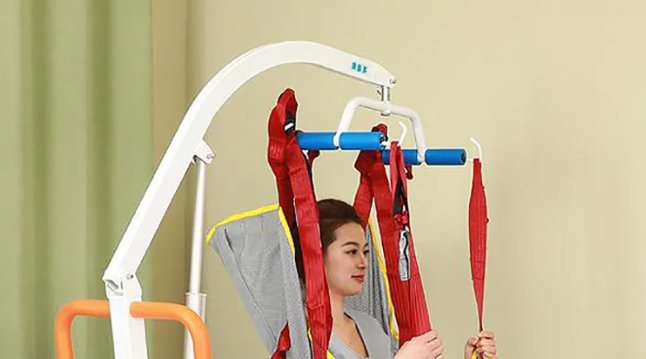
Question 5: What is the correct order for connecting the sling hooks?
Correct Answer: Connect the hooks from far to nearOperation Principle:
First connect the sling loops that are farther away from the operator.
Then connect the sling loops that are closer to the operator.
Ensure the sling is balanced after connection.
Double-check that all hooks are fully locked.
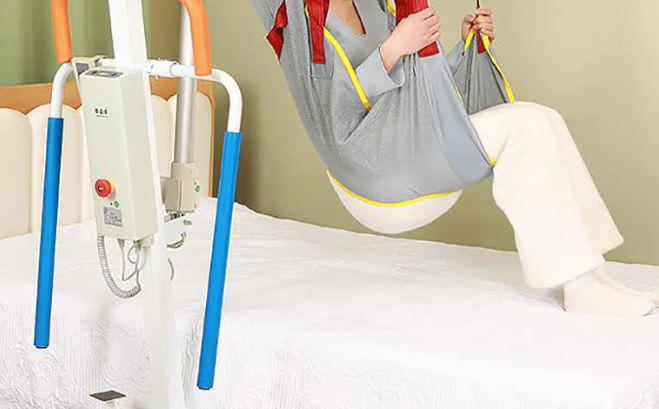
Question 6: What is the proper height for lifting the user?
Correct Answer: 15–20 centimeters above the bed surfaceSafety Considerations:
The height is sufficient to avoid the bed edge and obstacles.
A lower center of gravity enhances stability.
It makes it easier to control the direction of movement.
It reduces potential injuries in case of a fall.
Explanations for Scenario Application Questions
Question 7: What should you do first when operating in a narrow bathroom?
Correct Answer: Assess the space and remove obstaclesStep-by-Step Operation Guide:
Measure the dimensions of the doorway and the internal space.
Remove unnecessary items and obstacles.
Confirm there is enough operating radius.
Plan the optimal transfer path.
Prepare for necessary space adjustments.
Question 8: How should you adjust the operation when caring for a hemiplegic patient?hoyer lift quiz answers
Correct Answer: Offset the suspension point toward the affected side to maintain balanceProfessional Tips:
Understand the patient’s specific hemiplegia pattern.
Use the boom adjustment function to balance the center of gravity.
Pay special attention to supporting and protecting the affected side.
Closely observe the patient’s response during the operation.
Explanations for Maintenance Questions
Question 9: What is the most important item for daily maintenance?
Correct Answer: Check the integrity of the sling and clean the equipmentMaintenance Key Points:
Inspect the sling for wear after each use.
Clean the equipment surface regularly.
Check for leaks in the hydraulic system.
Test the functionality of all safety devices.
Question 10: What is the correct way to store the equipment?
Correct Answer: Store it in a dry environment with the base retractedStorage Specifications:
Store the equipment in a clean and dry environment.
Fully retract the base legs.
Store the sling separately to avoid pressure.
Regularly check the storage condition.
Explanations for Emergency Handling Questions
Question 11: What is the emergency measure when the hydraulic system fails?
Correct Answer: Use the emergency lowering valve to lower the lift slowlyOperation Steps:
Stay calm and reassure the user.
Locate and slowly rotate the emergency lowering valve.
Control the lowering speed to avoid rapid falling.
Stop using the equipment immediately after lowering.
Contact professional maintenance services.
Question 12: What should you do if you find a tear in the sling?
Correct Answer: Immediately stop using it and replace it with a new slingSafety Protocol:
Halt the current operation right away.
Use a spare sling to complete the transfer.
Mark the damaged sling to prevent misuse.
Document the damage and report it.
Explanations for Legal and Regulatory Questions
Question 13: What are the main legal responsibilities of the operator?
Correct Answer: Comply with the manufacturer’s guidelines and safety standardsLegal Requirements:
Complete the required training and certification.
Follow the standard operating procedures.
Conduct necessary equipment inspections.
hoyer lift quiz answers
hoyer lift quiz answers
Document the operation and maintenance processes.
Question 14: What is the time requirement for accident reporting?
Correct Answer: Complete the initial report within 24 hoursReporting Specifications:
Verbally report to the supervisor immediately.
Submit a written report within 24 hours.
Document the details of the accident thoroughly.
Preserve relevant evidence materials.
Explanations for Special Situation Questions
Question 15: What are the special precautions when the caregiver operates alone?
Correct Answer: Ensure access to emergency help channelsSafety Measures:
Carry a mobile phone or pager with you.
Inform others of the operation plan.
Avoid high-risk operations.
Check communication devices regularly.
Question 16: What are the key points for operating with bariatric patients?
Correct Answer: Use heavy-duty equipment and coordinate with multiple peopleProfessional Guidance:
Select heavy-duty equipment with appropriate weight capacity.
Arrange enough personnel to assist.
Adopt a step-by-step lifting strategy.
Closely monitor the stability of the equipment.
Explanations for Knowledge Comprehension Questions
Question 17: What is the main design purpose of the Hoyer Lift?
Correct Answer: Provide safe mechanical transfer and protect the safety of both partiesDesign Concept:
Eliminate the risk of injury from manual lifting.
Provide dignity for people with limited mobility.
Standardize the transfer operation process.
Improve the quality and efficiency of care.
Question 18: Why should you not exceed the weight capacity limit?
Correct Answer: To avoid equipment failure and serious injuriesEngineering Principles:
Exceeding the design stress leads to structural fatigue.
The hydraulic system may fail suddenly.
Reduced stability increases the risk of tipping.
Safety devices may not function properly.
Conclusion
Mastering correct Hoyer Lift knowledge and verifying your understanding through quizzes is the foundation of ensuring safe care. hoyer lift quiz answers Behind each correct answer lies important safety principles and operational experience. Participating in knowledge quizzes regularly is not just for passing assessments, but also for continuously strengthening safety awareness and updating professional knowledge. In care work, knowledge is the best safety guarantee, and understanding is the most reliable operation guide. Let us provide the safest and most professional care services for every user through continuous learning and reflection.